
SME and Startup Funding Trends in India 2026: Capital, Confidence and the New Growth Cycle
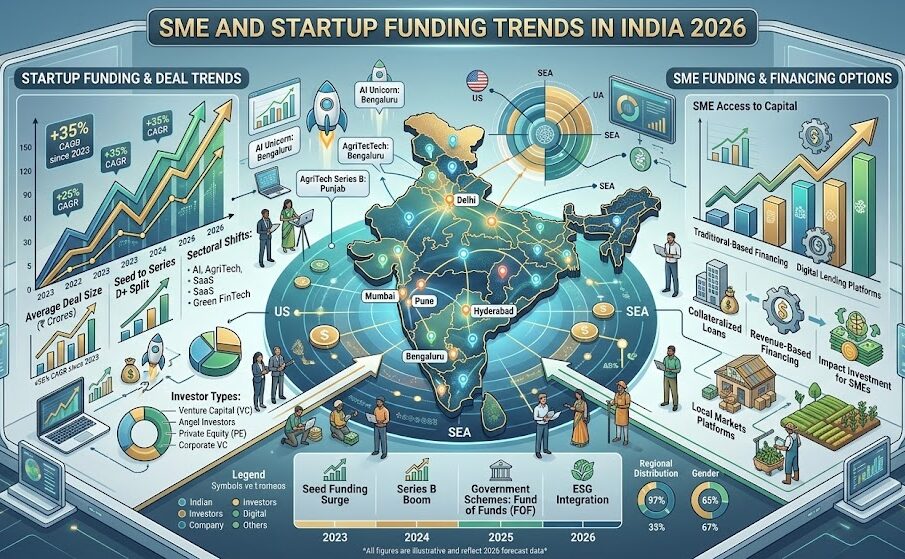
India’s entrepreneurial landscape has evolved rapidly over the last decade. From technology startups to manufacturing units in tier-2 cities, small and medium enterprises (SMEs) are no longer peripheral contributors to the economy. They are central to job creation, innovation and GDP growth.
In 2026, funding patterns for SMEs and startups are undergoing an important shift. The earlier phase of aggressive venture capital expansion has matured into a more disciplined, performance-driven funding environment. Investors are cautious but confident. Entrepreneurs are ambitious but more financially aware.
This article explores how SME and startup funding is shaping up in India in 2026, what trends are emerging, and what this means for business growth and the broader economy.
The Importance of SMEs in India’s Economy
SMEs contribute significantly to India’s GDP and employment. They operate across manufacturing, services, retail, agriculture support, technology and exports.
In 2026, the SME sector benefits from:
- Digital adoption
- Improved access to formal credit
- Government support programs
- Integration into global supply chains
Startups, especially in fintech, health tech, edtech, climate tech and artificial intelligence, continue to influence India’s innovation ecosystem.
Funding remains the fuel that powers this growth.
Shift in Venture Capital Strategy
During earlier years, venture capital funding often prioritized rapid expansion and user growth over profitability. In 2026, the funding environment is more balanced.
Focus on Profitability
Investors now prioritize:
- Sustainable revenue models
- Clear path to profitability
- Strong unit economics
- Cost discipline
Startups are expected to demonstrate financial prudence rather than just aggressive expansion.
Sector-Specific Funding
Capital is flowing selectively into sectors with strong long-term demand, such as:
- Climate and clean technology
- Financial services innovation
- Healthcare solutions
- Enterprise software
- Logistics and supply chain technology
Generalized funding without strategic focus has reduced compared to earlier cycles.
Rise of Domestic Investment
One significant trend in 2026 is the rise of domestic institutional participation.
Earlier, foreign venture capital dominated India’s startup ecosystem. Now, Indian family offices, domestic venture funds and corporate investors are playing a larger role.
This shift reduces over-dependence on global capital cycles and provides greater stability to the funding ecosystem.
Government Support and Policy Framework
Government initiatives continue to support SME and startup growth.
Key policy drivers include:
- Credit guarantee schemes
- Startup recognition programs
- Tax incentives
- Simplified compliance processes
- Digital registration platforms
Public sector banks and financial institutions have expanded lending under priority sector norms, making formal credit more accessible.
The focus is not just on funding technology startups in metropolitan cities but also on supporting manufacturing and service SMEs in smaller towns.
Alternative Funding Channels
In 2026, funding options for SMEs have diversified beyond traditional bank loans and venture capital.
1. Private Equity
Mid-sized profitable businesses are attracting private equity investments. These investors focus on scaling operations, improving governance and preparing companies for eventual listing.
2. Angel Networks
High-net-worth individuals are actively investing in early-stage ventures, especially in niche sectors.
3. Revenue-Based Financing
This model allows startups to raise capital in exchange for a percentage of future revenue, rather than equity dilution. It is gaining popularity among founders who want to retain ownership control.
4. Crowdfunding Platforms
Regulated crowdfunding models are emerging as supplementary capital sources for innovative projects.
Bank Lending to SMEs
Traditional banks are increasingly leveraging technology to evaluate SME creditworthiness.
AI-driven credit assessment tools allow banks to analyze transaction history, GST filings, invoice flows and cash patterns. This reduces dependency on collateral-heavy lending models.
As a result:
- Loan approval time has shortened.
- Informal businesses are transitioning into formal credit systems.
- Working capital access has improved.
However, interest rate sensitivity remains a factor influencing borrowing decisions.
Startup Valuation Reset
After periods of high valuations in previous years, 2026 has seen more realistic pricing of startup equity.
Investors are valuing businesses based on:
- Revenue growth consistency
- Margin stability
- Customer retention rates
- Operational efficiency
This correction has strengthened the ecosystem by discouraging speculative valuations and promoting disciplined capital allocation.
IPO and Exit Environment
The initial public offering market for startups has become more selective.
Companies approaching public markets in 2026 are expected to demonstrate:
- Profitable operations
- Strong governance frameworks
- Transparent financial reporting
- Stable revenue streams
Exits through mergers and acquisitions are also increasing. Larger corporations are acquiring innovative startups to strengthen their technological capabilities.
Sector Trends in 2026
Climate and Sustainability Ventures
Funding in renewable energy solutions, carbon management platforms and sustainable manufacturing startups is rising steadily.
Fintech Evolution
Fintech remains active, though with greater regulatory oversight. Companies focusing on lending infrastructure, payment security and financial analytics are attracting attention.
Healthcare and Biotechnology
Post-pandemic healthcare innovation continues. Diagnostic platforms, telemedicine and biotech startups are seeing investor interest.
Manufacturing and Supply Chain
With India positioning itself as a global manufacturing hub, SMEs in electronics, auto components and specialty materials are receiving strategic investments.
Challenges Facing Entrepreneurs
Despite improved funding diversity, startups and SMEs face several challenges.
1. Access to Growth Capital
Early-stage funding may be accessible, but scaling beyond initial stages still requires strong financial discipline.
2. Regulatory Compliance
As businesses grow, compliance requirements increase. Smaller firms may struggle with administrative burdens.
3. Global Market Uncertainty
Export-oriented SMEs are sensitive to global demand fluctuations.
4. Competition
High competition within popular sectors can impact margins and investor confidence.
Financial Discipline as a Core Theme
One defining characteristic of 2026 is financial discipline.
Entrepreneurs are more focused on:
- Cash flow management
- Cost optimization
- Sustainable expansion
- Measured hiring practices
This maturity signals the evolution of India’s startup ecosystem from experimental growth to structured enterprise development.
Role of Technology in Funding
Digital platforms are simplifying fundraising processes.
Startups now use:
- Online investor matchmaking platforms
- Data rooms for transparent due diligence
- Virtual pitch presentations
- Digital compliance documentation
Technology reduces geographical barriers, enabling startups from smaller cities to access national and global investors.
Economic Impact of SME Growth
SME and startup funding has direct macroeconomic implications.
- Job creation increases household income.
- Innovation boosts productivity.
- Export growth strengthens foreign exchange reserves.
- Local supply chains become more resilient.
In 2026, the SME ecosystem contributes significantly to economic diversification.
Investor Outlook
Investors in 2026 are cautious but optimistic.
They prioritize:
- Governance standards
- Ethical business practices
- Transparent reporting
- Long-term growth vision
Short-term speculation has declined. Long-term partnership models are becoming more common.
The Road Ahead
Looking forward, SME and startup funding in India is expected to:
- Become more structured and regulated.
- Integrate deeper technology-driven evaluation methods.
- Encourage sector-specific specialization.
- Strengthen domestic investor participation.
- Expand beyond metro cities into emerging business hubs.
The ecosystem is moving toward stability rather than volatility.
Conclusion
SME and startup funding trends in India in 2026 reflect maturity, discipline and strategic growth.
While capital remains available, it flows selectively toward businesses that demonstrate sustainable models and strong governance. Domestic participation is rising, valuation standards are stabilizing and funding channels are diversifying.
India’s entrepreneurial journey is entering a phase where innovation is balanced with responsibility. For founders, this environment demands resilience and clarity. For investors, it offers opportunities rooted in real economic value rather than speculative momentum.
As the funding landscape evolves, SMEs and startups will continue to shape India’s economic transformation in meaningful ways.







-
Deep Fake Love (2023) — Romance, Reality, and Digital Deception
Set inside a luxurious villa, the show brings together young, attractive, and ...