
AI in Indian Banking 2026: How Artificial Intelligence Is Transforming Loans, Credit and Fraud Detection
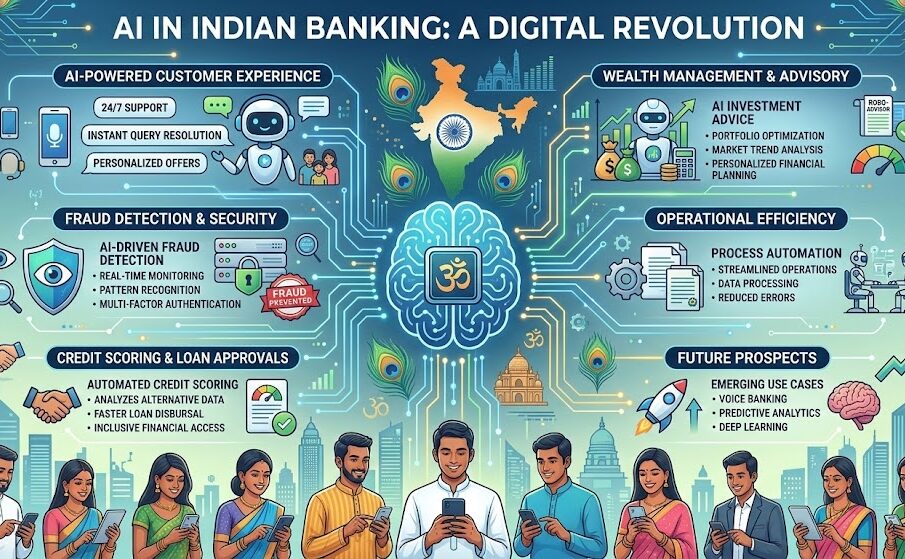
India’s banking sector has changed more in the last ten years than in the previous fifty. Digital payments, mobile banking, instant account opening and fintech innovation have reshaped customer expectations. In 2026, another powerful force is driving this transformation — Artificial Intelligence.
Artificial Intelligence, or AI, is no longer a futuristic experiment in Indian banking. It is actively influencing how loans are approved, how fraud is detected, how customers are served and how financial risks are managed.
This article explores how AI is reshaping Indian banking in 2026, what it means for customers and institutions, and what the future could look like.
The Rise of AI in Indian Banking
Indian banks operate in one of the most complex financial ecosystems in the world. With millions of transactions occurring every minute and a rapidly expanding customer base, traditional manual systems are no longer sufficient.
AI provides banks with:
- Faster data processing
- Smarter risk analysis
- Automated customer service
- Real-time fraud detection
- Improved operational efficiency
As competition increases between traditional banks and fintech companies, AI adoption has become a necessity rather than a luxury.
AI in Loan Processing and Credit Assessment
One of the most significant applications of AI in 2026 is in lending.
Traditional Loan Assessment
Earlier, loan approvals relied heavily on:
- Manual documentation
- Limited credit score evaluation
- Income verification through physical records
- Lengthy processing timelines
This system often excluded individuals without strong formal credit histories.
AI-Driven Credit Scoring
AI systems now analyze large datasets to evaluate creditworthiness. Instead of relying only on traditional credit bureau scores, AI models assess:
- Digital payment behavior
- Transaction patterns
- Income stability trends
- Spending consistency
- Utility bill payment history
- E-commerce activity
This approach allows banks to assess borrowers more accurately, especially first-time borrowers and small business owners.
As a result, credit access is expanding, particularly for MSMEs and young professionals.
Faster Loan Disbursement
In 2026, many personal loans and small business loans are approved within minutes. AI systems automatically verify documents, evaluate risk and generate loan decisions with minimal human intervention.
This improves customer satisfaction while reducing operational costs for banks.
AI in Fraud Detection
With increasing digital transactions, fraud risk has also grown. AI plays a critical role in protecting customers and financial institutions.
Real-Time Transaction Monitoring
AI algorithms monitor transaction patterns in real time. If a transaction deviates from normal behavior, the system flags it instantly.
For example:
- Sudden large international transfer
- Multiple rapid transactions from unknown locations
- Login attempts from unusual devices
AI systems learn from historical fraud cases and continuously refine detection accuracy.
Reduced False Positives
Earlier fraud detection systems often blocked legitimate transactions. AI reduces false alarms by analyzing contextual patterns rather than rigid rules.
This improves customer experience while maintaining security.
Chatbots and Virtual Assistants
Customer service has undergone a visible transformation.
AI-powered chatbots now handle:
- Account balance inquiries
- Transaction history requests
- Card blocking
- Loan status updates
- Basic financial queries
These virtual assistants operate 24/7, reducing pressure on call centers and improving response time.
In 2026, conversational AI has improved significantly. Customers can interact in multiple languages, including regional Indian languages, increasing accessibility.
Personalized Banking Experience
AI allows banks to offer personalized financial recommendations.
Based on transaction behavior and financial goals, AI systems suggest:
- Investment products
- Insurance coverage
- Credit card upgrades
- Savings plans
- EMI restructuring options
This level of personalization was difficult to achieve manually at scale.
For banks, personalized offerings improve cross-selling opportunities and customer retention.
Risk Management and Predictive Analytics
Risk management is central to banking stability.
AI helps banks predict potential defaults by analyzing early warning signals such as:
- Declining cash flow patterns
- Increasing debt obligations
- Irregular repayment behavior
- Sector-specific economic stress
Predictive analytics allow banks to intervene early, restructure loans or adjust exposure limits.
This strengthens financial stability and reduces non-performing assets over time.
AI in Wealth Management
Private banks and wealth management firms are using AI-driven tools for portfolio management.
Robo-advisory platforms analyze:
- Market conditions
- Investor risk tolerance
- Asset allocation models
- Historical performance trends
These systems provide automated portfolio suggestions at lower cost compared to traditional advisory services.
In 2026, AI-assisted wealth management is growing among retail investors seeking cost-efficient financial guidance.
AI and Financial Inclusion
India’s financial inclusion efforts benefit significantly from AI.
Many individuals in rural and semi-urban areas lack formal credit histories. AI-based alternative credit assessment models allow banks to evaluate borrowers using digital footprints and behavioral data.
This expands credit access to underserved populations while managing risk responsibly.
Additionally, AI-powered vernacular chat interfaces make digital banking accessible to users who are not comfortable with English.
Operational Efficiency and Cost Reduction
Banks manage massive back-office operations including compliance checks, document verification and transaction reconciliation.
AI-driven automation reduces:
- Manual data entry
- Processing delays
- Human error
- Administrative costs
This efficiency enables banks to allocate resources toward growth and innovation rather than repetitive tasks.
Regulatory and Ethical Considerations
While AI brings advantages, it also raises important concerns.
Data Privacy
AI systems rely on large volumes of customer data. Protecting personal information is critical.
Banks must comply with data protection regulations and maintain transparency about how data is used.
Algorithmic Bias
If AI models are trained on biased datasets, they may produce unfair outcomes. Ensuring fairness and accountability in credit decisions is essential.
Regulatory Oversight
Regulators are developing frameworks to ensure responsible AI deployment. Transparent audit trails and explainable AI models are becoming important compliance requirements.
Competition Between Banks and Fintech
Fintech companies are often more agile in adopting AI technologies.
To remain competitive, traditional banks are:
- Partnering with fintech firms
- Investing in in-house AI development
- Acquiring technology startups
- Modernizing core banking systems
This competitive environment accelerates innovation across the sector.
Cybersecurity and AI
AI is not only used for fraud detection but also for cybersecurity monitoring.
Machine learning systems identify unusual network activity, malware threats and data breach attempts.
As cyber threats evolve, AI-driven defense mechanisms become increasingly critical.
Economic Impact of AI Adoption
AI integration strengthens the overall financial system by:
- Improving credit allocation efficiency
- Reducing systemic fraud losses
- Enhancing customer trust
- Increasing operational productivity
Over time, efficient banking contributes to broader economic growth by supporting business expansion and consumer spending.
Challenges Ahead
Despite rapid progress, AI adoption faces obstacles:
- High implementation cost
- Need for skilled data scientists
- Integration with legacy banking systems
- Regulatory compliance complexity
Smaller banks may struggle to match the AI capabilities of larger institutions.
However, cloud-based AI solutions are making advanced technology more accessible.
Future Outlook
Looking beyond 2026, AI’s role in Indian banking is expected to deepen further.
Potential future developments include:
- Voice-based banking transactions
- Fully automated credit underwriting
- AI-powered financial planning platforms
- Predictive economic risk modeling
- Advanced biometric authentication systems
AI is likely to become embedded in nearly every aspect of banking operations.
Conclusion
Artificial Intelligence in Indian banking in 2026 represents a structural transformation rather than a temporary trend.
From faster loan approvals to smarter fraud detection, from personalized financial services to predictive risk management, AI is reshaping how banks operate and how customers interact with financial institutions.
While challenges such as privacy, regulation and ethical deployment remain important, the overall trajectory is clear. AI is strengthening efficiency, expanding financial inclusion and enhancing system stability.
India’s banking sector is evolving into a technology-driven ecosystem where data, automation and intelligence work together to create faster, safer and more accessible financial services.


Leave a reply





-
Manali – A Dream Destination Where Mountains Whisper and Rivers Sing
Manali is more than a tourist destination — it is an experience ...