
ETFs vs. Mutual Funds vs. Stocks: Understanding the Key Differences Before You Invest
If you are planning to start investing, one of the first questions you’ll face is this:
Should I invest in ETFs, Mutual Funds, or Stocks?
All three are popular investment options, but they work differently. Each has its own risk level, return potential, flexibility, and suitability depending on your financial goals.
Understanding the difference between ETFs, mutual funds, and stocks can help you make smarter decisions and avoid costly mistakes. Let’s break everything down in a simple, practical way.
What Are Stocks?
Stocks represent ownership in a company. When you buy a stock, you become a shareholder of that company.
For example, if you buy shares of a publicly listed company, you own a small part of that business. If the company performs well, the stock price may rise. If it struggles, the price may fall.
How Stocks Work
- You buy individual company shares.
- Prices fluctuate throughout the trading day.
- Returns come from price appreciation and dividends.
Pros of Investing in Stocks
- High return potential
- Full control over which companies you invest in
- Liquidity (can buy and sell anytime during market hours)
Cons of Investing in Stocks
- High risk
- Requires research and monitoring
- Not diversified unless you buy multiple stocks
Stocks are suitable for investors who:
- Understand market movements
- Can handle volatility
- Want direct control over investments
What Are Mutual Funds?
Mutual funds pool money from many investors and invest it in a diversified portfolio of stocks, bonds, or other securities.
A professional fund manager manages the portfolio and decides where to invest.
How Mutual Funds Work
- Investors buy units of the fund.
- The fund invests in multiple securities.
- Returns depend on overall portfolio performance.
- Prices are calculated once daily (NAV – Net Asset Value).
Types of Mutual Funds
- Equity Funds (invest mainly in stocks)
- Debt Funds (invest in bonds)
- Hybrid Funds (mix of equity and debt)
- Index Funds (track a specific index)
Pros of Mutual Funds
- Professional management
- Diversification
- Suitable for SIP (Systematic Investment Plan)
- Good for beginners
Cons of Mutual Funds
- Expense ratio (management fees)
- Less control over stock selection
- Not traded in real time
Mutual funds are ideal for:
- Long-term investors
- Beginners
- People who prefer expert management
What Are ETFs (Exchange-Traded Funds)?
ETFs are similar to mutual funds in that they hold a basket of securities. However, they trade on stock exchanges just like individual stocks.
Most ETFs track an index, such as Nifty 50 or Sensex.
How ETFs Work
- They track an index or sector.
- Traded on exchanges during market hours.
- Price changes throughout the day.
Pros of ETFs
- Lower expense ratio than most mutual funds
- Real-time trading
- Diversification
- Transparency
Cons of ETFs
- Requires a demat and trading account
- Brokerage charges apply
- Slight tracking error possible
ETFs are suitable for:
- Cost-conscious investors
- Passive investors
- Long-term wealth builders
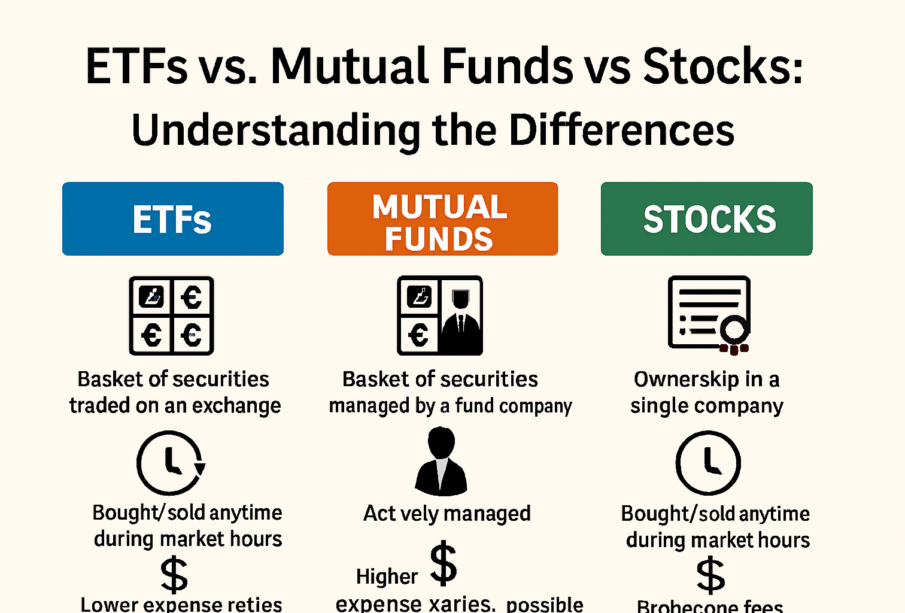
Key Differences Between ETFs, Mutual Funds, and Stocks
| Feature | Stocks | Mutual Funds | ETFs |
|---|---|---|---|
| Ownership | Individual company | Basket of securities | Basket of securities |
| Diversification | Low (unless multiple stocks) | High | High |
| Management | Self-managed | Professionally managed | Mostly passive |
| Trading | Real-time | Once per day | Real-time |
| Risk Level | High | Moderate | Moderate |
| Expense Ratio | No management fee | Higher fees | Lower fees |
| Minimum Investment | Price of one share | Can start small via SIP | Price of one unit |
Risk Comparison
Stocks – Highest Risk
If the company performs poorly, your investment can fall sharply. There is no diversification unless you build it yourself.
Mutual Funds – Moderate Risk
Risk depends on fund type. Equity funds are riskier than debt funds. Diversification reduces company-specific risk.
ETFs – Moderate Risk
Similar to index mutual funds but usually cheaper. Risk depends on the index or sector they track.
Return Potential
- Stocks: Highest potential returns, but also highest volatility.
- Mutual Funds: Stable long-term returns if chosen wisely.
- ETFs: Returns match the index performance.
Long-term investors often benefit from compounding through mutual funds or ETFs.
Cost Comparison
Stocks
- Brokerage fees
- No management fees
Mutual Funds
- Expense ratio (1%–2% or more depending on fund)
- Exit load (in some cases)
ETFs
- Lower expense ratio (often 0.1%–0.5%)
- Brokerage charges per trade
Cost matters significantly over long investment periods.
Which Is Better for Beginners?
For someone new to investing:
- Mutual funds are beginner-friendly.
- ETFs are great if you understand basic trading.
- Stocks require research and emotional discipline.
If you don’t want to track markets daily, mutual funds or ETFs may be better.
Which Option Builds Wealth Faster?
It depends on:
- Risk tolerance
- Investment duration
- Knowledge level
- Discipline
Stocks can give faster returns but can also cause losses quickly.
Mutual funds and ETFs are generally better for long-term systematic wealth creation.
Long-Term Investing Strategy
Many experienced investors combine all three:
- Core portfolio in ETFs or index mutual funds
- Active mutual funds for growth
- Selected individual stocks for high returns
Diversification reduces overall risk while maintaining growth potential.
Tax Considerations (India Perspective)
Stocks & Equity Mutual Funds
- Short-term capital gains (under 1 year) taxed at 15%
- Long-term capital gains (above 1 year) taxed at 10% beyond exemption limit
Debt Mutual Funds
- Taxed as per income slab (as per current rules)
ETFs follow similar taxation depending on asset type.
Always check updated tax regulations before investing.
When Should You Choose Each?
Choose Stocks if:
- You enjoy researching companies
- You can handle volatility
- You want high growth potential
Choose Mutual Funds if:
- You prefer professional management
- You invest via SIP
- You want diversification without effort
Choose ETFs if:
- You want low-cost investing
- You prefer passive investing
- You already have a demat account
Final Thoughts
There is no single “best” investment option. The right choice depends on your financial goals, risk appetite, and investment knowledge.
Stocks offer control and high growth potential.
Mutual funds offer convenience and expert management.
ETFs offer low-cost diversification and flexibility.
If you’re building long-term wealth, understanding these differences will help you make informed decisions instead of following trends blindly.
The smartest investors focus not just on returns — but on strategy, discipline, and consistency.








-
Dhurandhar (2025): A Powerful Story of Courage, System, and Truth
This is not just an action film. It is a story about ...