
India’s Digital Rupee (CBDC) in 2026: Impact on Banking, Payments and the Financial Future
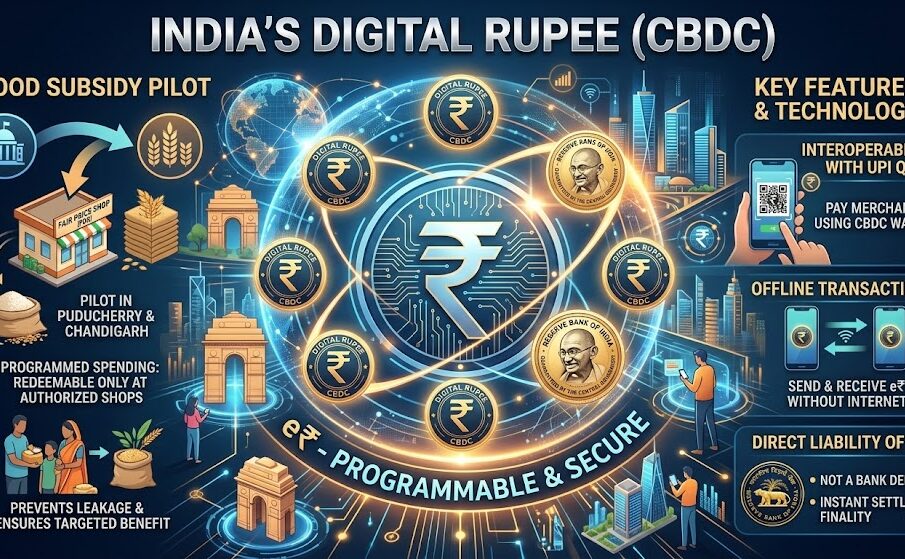
India’s financial system has gone through multiple transformations over the last decade. From the rapid growth of UPI payments to the rise of fintech startups, digital adoption has reshaped how money moves in the country. In 2026, one of the most significant developments in this journey is the expansion of the Digital Rupee — India’s Central Bank Digital Currency (CBDC).
The Digital Rupee is not cryptocurrency. It is not a private token. It is a sovereign digital currency issued and regulated by the Reserve Bank of India (RBI). And its gradual expansion is beginning to influence banks, businesses, fintech platforms and consumers alike.
This article explores what the Digital Rupee means in 2026, how it works, its impact on banking and payments, and what it could mean for India’s financial future.
What Is the Digital Rupee?
The Digital Rupee is the electronic form of India’s physical currency. Just like paper notes are issued by the RBI, the Digital Rupee is also issued by the central bank, but in digital form.
There are two primary forms:
- Retail CBDC: For everyday public use.
- Wholesale CBDC: For interbank settlements and large financial transactions.
Unlike cryptocurrencies that operate on decentralized networks, the Digital Rupee is centrally controlled and backed by the government. It carries the same value as physical cash and is considered legal tender.
In simple terms, if you hold Digital Rupee in your wallet, it is equivalent to holding physical cash in digital form.
Why India Introduced CBDC
India’s financial system is already highly digitized. UPI transactions run into billions every month. So why introduce a Digital Rupee?
There are several strategic reasons:
- To reduce dependency on physical cash.
- To improve transaction transparency.
- To reduce settlement risks in large financial transfers.
- To strengthen monetary policy transmission.
- To stay aligned with global digital currency developments.
Globally, several central banks are exploring digital currencies. For India, launching CBDC ensures that it remains at the forefront of financial innovation.
How the Digital Rupee Works in Practice
In 2026, selected banks and fintech platforms allow users to hold Digital Rupee through approved digital wallets. Users can transfer Digital Rupee peer-to-peer, similar to sending money via UPI.
However, the fundamental difference lies in settlement.
With traditional digital payments, money moves between bank accounts. With CBDC, the Digital Rupee itself is transferred directly from one wallet to another. There is no intermediary settlement layer in the same way as conventional banking systems.
For wholesale CBDC, interbank transactions settle faster and more efficiently, reducing liquidity risk and operational delays.
Impact on Banks in 2026
One of the biggest discussions around CBDC is its impact on traditional banks.
1. Deposit Structure Changes
If individuals start holding significant funds in Digital Rupee wallets instead of bank deposits, banks could see a shift in deposit patterns. This may influence how banks manage liquidity and lending.
However, in 2026, most people still use CBDC for transactional purposes rather than savings storage.
2. Payment Infrastructure Evolution
Banks are integrating CBDC wallets into their digital banking apps. This ensures they remain relevant in the new system rather than being bypassed.
3. Reduced Settlement Risk
Wholesale CBDC improves large-value transaction settlement between banks. This reduces systemic risk and increases efficiency in financial markets.
Overall, banks are adapting rather than being disrupted.
Impact on Payment Ecosystem
India’s digital payment system is already one of the most advanced globally. UPI, QR payments and mobile banking dominate transactions.
The Digital Rupee adds another layer to this ecosystem.
Faster Final Settlement
Unlike certain payment systems that rely on backend reconciliation, CBDC offers near-instant final settlement.
Lower Transaction Costs
Over time, CBDC may reduce operational costs for large transactions.
Increased Transparency
Digital Rupee transactions are traceable within regulatory frameworks. This may help in reducing illicit financial activity and improving tax compliance.
However, privacy concerns remain an important public discussion topic.
Digital Rupee vs UPI: Are They Competitors?
A common question in 2026 is whether CBDC will replace UPI.
The answer is no — at least not in the near term.
UPI is a payment interface that connects bank accounts. The Digital Rupee is a currency form.
UPI could actually integrate CBDC in the future. Instead of transferring money from one bank account to another, UPI platforms may allow users to transfer Digital Rupee directly.
In that sense, they can complement each other rather than compete.
Impact on Monetary Policy
One of the most important aspects of CBDC is its potential influence on monetary policy.
In the long term, CBDC may allow the central bank to:
- Monitor liquidity flows more effectively.
- Implement targeted stimulus measures.
- Improve policy transmission speed.
While India is still in a controlled expansion phase of CBDC, economists believe the technology opens new possibilities for financial governance.
Financial Inclusion Benefits
India has made significant progress in financial inclusion through Jan Dhan accounts and mobile banking.
The Digital Rupee may further support inclusion by:
- Reducing dependency on physical bank branches.
- Enabling low-cost digital wallets.
- Supporting offline payment capabilities in remote areas.
If implemented efficiently, CBDC could help bring more people into the formal financial system.
Risks and Concerns
While the Digital Rupee has advantages, there are concerns to consider.
1. Privacy Issues
Since CBDC transactions are digitally recorded, citizens worry about transaction privacy. The challenge is balancing transparency with individual rights.
2. Cybersecurity Risks
As digital currency adoption increases, cyber threats also become more sophisticated. Strong cybersecurity frameworks are essential.
3. Bank Disintermediation
If large deposits shift from banks to CBDC wallets, banks’ lending capacity could be affected. Regulators must manage this transition carefully.
4. Technology Access Gap
Not all citizens have smartphones or reliable internet. Bridging this digital divide remains important.
Business and Corporate Impact
Businesses in 2026 are slowly exploring CBDC integration.
Large corporations see benefits in:
- Faster cross-border trade (if global CBDC frameworks align).
- Reduced settlement time.
- Lower operational friction.
Startups and fintech companies are building new services around digital currency infrastructure, creating fresh innovation opportunities.
Global Perspective
India is not alone in exploring digital currency. Several countries are testing or piloting CBDCs.
India’s advantage lies in its already strong digital infrastructure. With Aadhaar, UPI and widespread smartphone adoption, the country has the foundation required for CBDC scalability.
This positions India as a leader among emerging economies in digital financial transformation.
Will the Digital Rupee Replace Cash?
In 2026, cash remains widely used in India, especially in rural and informal sectors.
The Digital Rupee is not designed to eliminate cash immediately. Instead, it offers an alternative.
Over time, as digital literacy increases and trust builds, usage may expand. But a complete shift away from physical currency is unlikely in the near future.
Investment and Economic Outlook
For investors, CBDC development signals long-term digital transformation.
Sectors that may benefit include:
- Banking technology providers
- Cybersecurity firms
- Payment infrastructure companies
- Fintech platforms
While CBDC itself is not an investment asset like stocks, its ecosystem creates business opportunities.
From an economic standpoint, smoother settlement systems and better liquidity monitoring can enhance financial stability.
The Road Ahead
The expansion of the Digital Rupee in 2026 is measured and strategic. Instead of rapid nationwide rollout, authorities are testing, refining and gradually increasing adoption.
The future may include:
- Offline CBDC transactions.
- Cross-border CBDC settlements.
- Integration with existing payment apps.
- Expanded merchant acceptance.
India’s approach appears cautious but forward-looking.
Conclusion
The Digital Rupee in 2026 represents the next stage in India’s digital financial evolution. It is not a dramatic overnight revolution, but a steady transformation.
Banks are adapting. Payment systems are evolving. Policymakers are experimenting carefully. Consumers are gradually becoming familiar with the concept.
While challenges such as privacy, cybersecurity and liquidity management remain, the overall direction suggests that CBDC will become an important part of India’s financial architecture in the coming years.
For a country that has already led the world in digital payment innovation, the Digital Rupee is a natural progression.
India’s financial future is increasingly digital — and the Digital Rupee stands at the center of that transformation.



Leave a reply





-
Train to Busan (2016): The Ultimate Zombie Thriller That Redefined Korean Cinema
This in-depth, SEO-optimized article explores the plot, cast, themes, symbolism, box office ...