
Mastering the Debt Snowball vs. Debt Avalanche: Which Repayment Strategy Truly Works?
Debt can feel overwhelming. Credit cards, personal loans, student loans, car payments — when multiple balances pile up, it becomes difficult to know where to start. Many people don’t struggle because they lack income; they struggle because they lack a clear strategy.
Two of the most powerful and widely used debt repayment methods are the Debt Snowball and the Debt Avalanche. Both approaches work. Both can eliminate debt. But they operate very differently — psychologically and mathematically.
Understanding the difference between these two methods can help you choose the strategy that aligns with your personality, financial situation, and long-term goals.
This complete guide breaks down both methods, compares their advantages and disadvantages, and helps you decide which one can accelerate your path to financial freedom.
Why Having a Debt Repayment Strategy Matters
Without a structured plan, people often:
- Pay random amounts toward different debts
- Focus only on minimum payments
- Feel discouraged by slow progress
- Lose motivation midway
A strategy provides direction. It reduces emotional stress and transforms repayment into a systematic process rather than a guessing game.
What Is the Debt Snowball Method?
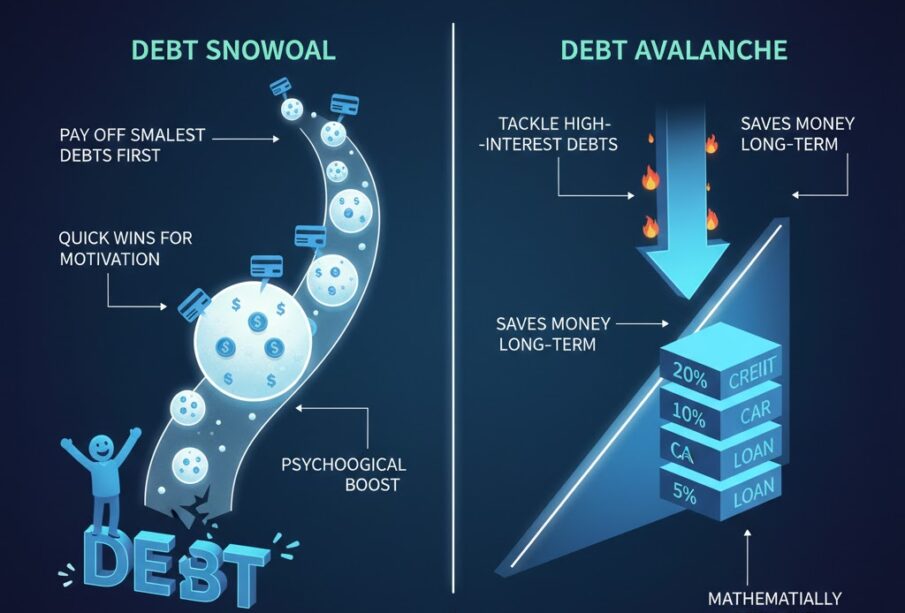
The Debt Snowball method focuses on paying off the smallest debt first — regardless of interest rate.
How It Works:
- List all debts from smallest balance to largest balance.
- Make minimum payments on all debts.
- Put any extra money toward the smallest debt.
- Once the smallest debt is paid off, roll that payment into the next smallest debt.
- Repeat until all debts are cleared.
The idea is simple: quick wins build momentum.
Why It’s Called a “Snowball”
When you pay off the smallest debt, the money you were using for that payment doesn’t disappear — it gets added to the next debt.
As you continue, your payment power grows larger and larger, just like a snowball rolling downhill.
Example of the Debt Snowball
Imagine you have:
- Credit Card A: ₹10,000
- Personal Loan: ₹40,000
- Car Loan: ₹1,20,000
Using the snowball method, you attack the ₹10,000 debt first, even if it has a lower interest rate than the others.
Once it’s paid off, you redirect that payment to the ₹40,000 loan.
Momentum builds with each elimination.
Psychological Power of the Debt Snowball
The Snowball method is powerful because it leverages human behavior.
Small victories:
- Boost confidence
- Reduce stress
- Increase motivation
- Reinforce discipline
Seeing one account fully closed feels emotionally rewarding. That emotional boost keeps people committed.
For many individuals, behavior matters more than math.
What Is the Debt Avalanche Method?
The Debt Avalanche method focuses on paying off the debt with the highest interest rate first.
How It Works:
- List all debts from highest interest rate to lowest.
- Make minimum payments on all debts.
- Put extra money toward the highest-interest debt.
- Once that debt is cleared, move to the next highest interest rate.
This strategy is mathematically efficient.
Why It’s Called an “Avalanche”
You’re attacking the debt that’s costing you the most money first. By eliminating high-interest balances early, you reduce total interest paid over time.
The avalanche prevents the snow from piling up — meaning interest doesn’t compound as aggressively.
Example of the Debt Avalanche
Using the same debts:
- Credit Card A: ₹10,000 at 18% interest
- Personal Loan: ₹40,000 at 12% interest
- Car Loan: ₹1,20,000 at 8% interest
Here, you would pay off the 18% credit card first — even if it’s not the smallest balance.
This reduces long-term interest expenses.
Debt Snowball vs Debt Avalanche: Key Differences
1. Focus
- Snowball: Smallest balance first
- Avalanche: Highest interest first
2. Motivation
- Snowball: Faster emotional wins
- Avalanche: Slower visible wins
3. Cost Efficiency
- Snowball: May cost more in interest
- Avalanche: Minimizes total interest paid
4. Behavioral Fit
- Snowball: Ideal for people who need momentum
- Avalanche: Ideal for disciplined, numbers-focused individuals
Which Method Saves More Money?
From a purely mathematical perspective, the Debt Avalanche saves more money in interest payments.
By targeting high-interest debt first, you reduce compounding costs faster.
However, the difference may not always be dramatic — especially if balances are similar.
The real question isn’t just “Which saves more money?”
It’s “Which will you stick with?”
The Behavioral Finance Factor
Financial decisions are rarely purely rational.
Many people start with the Avalanche method but lose motivation because large balances take longer to disappear.
The Snowball method often keeps people engaged because visible progress happens sooner.
Consistency beats perfection.
If the Snowball keeps you committed for years, it may outperform an Avalanche plan that you abandon halfway.
When the Debt Snowball Makes More Sense
Choose the Snowball method if:
- You feel overwhelmed by multiple debts
- Motivation drops easily
- You need quick psychological wins
- You’ve struggled with discipline before
Closing accounts builds confidence.
Confidence builds momentum.
When the Debt Avalanche Is the Better Choice
Choose the Avalanche method if:
- You’re highly disciplined
- You care about minimizing total interest
- You can stay motivated without quick wins
- Your high-interest debts are significantly expensive
If numbers motivate you, Avalanche is powerful.
The Hybrid Approach: A Smart Alternative
Some people combine both methods.
For example:
- Pay off one small debt quickly for motivation.
- Then switch to the Avalanche method for efficiency.
This blends emotional momentum with mathematical advantage.
There’s no rule that says you must strictly follow one strategy.
Common Mistakes When Paying Off Debt
Regardless of the method, avoid these mistakes:
1. Ignoring Emergency Savings
Without a small emergency fund, unexpected expenses can push you back into debt.
2. Closing Credit Too Quickly
Closing old accounts can affect credit history length.
3. Missing Minimum Payments
Late payments damage credit scores and add penalties.
4. Taking on New Debt
Repayment plans fail if new balances continue growing.
Discipline matters more than strategy.
How Interest Compounds Against You
High-interest debt grows faster than many realize.
For example, credit card interest can compound monthly. If you only make minimum payments, a debt can take years — even decades — to disappear.
Understanding compounding shifts urgency.
Interest works for you when investing.
It works against you when borrowing.
How to Choose the Right Strategy for You
Ask yourself:
- Do I need emotional motivation or financial efficiency?
- Have I struggled sticking to financial plans before?
- How large are my interest rate differences?
- What will reduce my stress faster?
Your personality matters.
There is no universally “correct” method — only the method you will consistently follow.
Debt Repayment and Credit Score Impact
As you reduce balances:
- Your credit utilization ratio improves.
- Your credit score may gradually increase.
- Lenders view lower debt more favorably.
Both Snowball and Avalanche positively impact credit if payments are consistent.
The Emotional Freedom of Becoming Debt-Free
Beyond numbers, becoming debt-free changes mindset.
Benefits include:
- Reduced financial anxiety
- Greater cash flow flexibility
- Increased savings capacity
- More investment opportunities
- Improved confidence
Debt freedom is psychological freedom.
Frequently Asked Questions
Is the Debt Snowball bad because it ignores interest rates?
Not necessarily. While it may cost slightly more in interest, its psychological benefits often lead to higher completion rates.
Does the Debt Avalanche always save more money?
Yes, mathematically it reduces total interest paid.
Can I switch methods midway?
Absolutely. Many people adjust strategies as motivation and financial situations change.
Which method is faster?
It depends on your balances and interest rates. Avalanche may be cheaper; Snowball may feel faster emotionally.
Final Thoughts: Strategy Is Powerful, But Action Is Everything
Both the Debt Snowball and Debt Avalanche are proven methods.
One prioritizes momentum.
The other prioritizes mathematics.
But neither works without commitment.
If you’re feeling stuck, start today. List your debts. Choose a strategy. Automate payments if possible. Track progress monthly.
The most important step isn’t choosing the perfect method.
It’s choosing a method — and sticking to it until every balance reaches zero.
Financial freedom isn’t built overnight.
It’s built payment by payment.



Leave a reply





-
Love Is Blind – Season 10: Everything You Need to Know
Let’s break down what makes this milestone season special, what fans can ...