
TAN Registration in India – Meaning, Applicability, Benefits & Step-by-Step Process (2026 Guide)
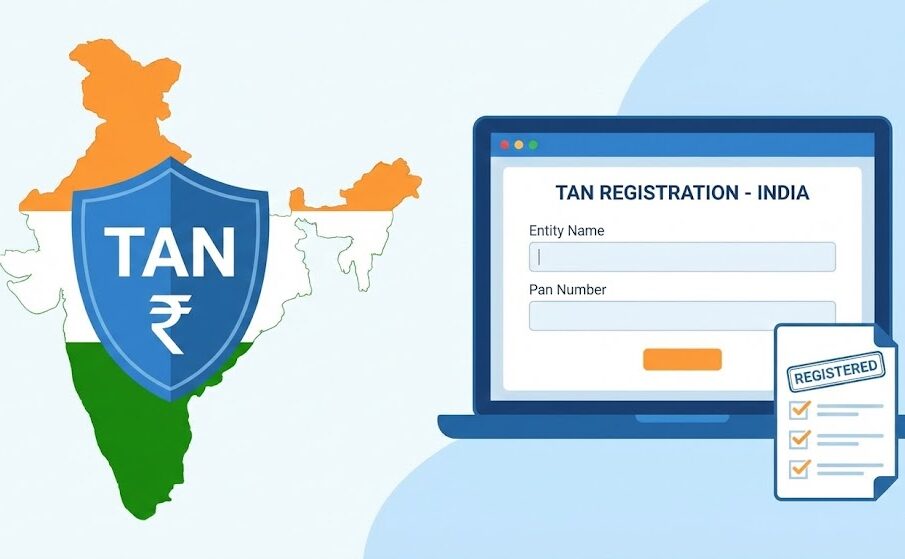
Tax compliance is one of the most important responsibilities of any business or employer in India. Among various tax-related registrations, TAN Registration (Tax Deduction and Collection Account Number) plays a crucial role for businesses that deduct or collect tax at source. Many business owners and professionals are familiar with PAN, but not everyone clearly understands TAN and when it is required.
TAN is a 10-digit alphanumeric number issued by the Income Tax Department of India to individuals and organizations responsible for deducting or collecting tax at source under the provisions of the Income Tax Act, 1961. Without TAN, a person or business cannot legally deduct or deposit TDS (Tax Deducted at Source).
This article explains TAN registration in a clear, practical, and comprehensive manner — covering what TAN is, who needs it, benefits, documents required, step-by-step process, fees, penalties, and common misconceptions.
What is TAN Registration?
TAN stands for Tax Deduction and Collection Account Number. It is a unique identification number issued by the Income Tax Department to:
- Employers
- Businesses
- Companies
- Firms
- Government departments
- Individuals who deduct TDS
Whenever tax is deducted from payments like salary, rent, professional fees, or contractor payments, TAN must be quoted in:
- TDS returns
- TDS challans
- TDS certificates (Form 16 / Form 16A)
- Income tax communications
Without TAN, TDS-related transactions are considered invalid.
Who Needs TAN Registration?
TAN registration is mandatory for anyone who:
- Deducts TDS from salary
- Deducts TDS from contractor payments
- Deducts TDS from professional fees
- Deducts TDS from rent payments
- Deducts TDS from interest payments
- Collects TCS (Tax Collected at Source)
This includes:
- Private limited companies
- LLPs
- Partnership firms
- Proprietorship businesses
- Government departments
- Trusts and NGOs
- Schools and colleges
- Hospitals
- Real estate developers
- Large retailers
- Professional consultants
If you are an employer or business that makes payments subject to TDS, you must obtain TAN.
Is TAN Required for Individuals?
Yes — if an individual is required to deduct TDS.
For example:
- A landlord who deducts TDS on rent above threshold
- A contractor who pays subcontractors
- A professional making large payments to consultants
In such cases, even individuals must apply for TAN.
Difference Between PAN and TAN
Many people confuse PAN and TAN, but both serve different purposes.
| PAN | TAN |
|---|---|
| Permanent Account Number | Tax Deduction Account Number |
| Used for income tax filing | Used for TDS transactions |
| Required for all taxpayers | Required only for TDS deductors |
| Issued by Income Tax Dept | Issued by Income Tax Dept |
If you are deducting TDS, you need both PAN and TAN.
Why is TAN Important?
1. Legal Requirement for TDS Deduction
You cannot deduct or deposit TDS without TAN.
2. Mandatory for Filing TDS Returns
Every TDS return requires TAN.
3. Required for Issuing TDS Certificates
Forms like:
- Form 16 (for employees)
- Form 16A (for contractors)
cannot be issued without TAN.
4. Avoids Penalties
Failure to obtain TAN can lead to fines and legal action.
Documents Required for TAN Registration
TAN application is mostly identity-based and does not require many documents.
You generally need:
- PAN of applicant
- Aadhaar card (for individuals)
- Business registration details (if company/LLP)
- Contact details (email & mobile)
- Address details
No supporting documents are usually required for online application.
Step-by-Step TAN Registration Process (Online)
TAN application is done through NSDL (now Protean eGov Technologies) website.
Step 1 – Visit NSDL Website
Go to the official NSDL TAN application page.
Step 2 – Select Form 49B
Choose Form 49B – Application for TAN.
Step 3 – Fill Application Details
You need to enter:
- Name of applicant
- Category (Company, Individual, Firm, etc.)
- Address
- Email ID
- Mobile number
- PAN details
Make sure all details are accurate.
Step 4 – Submit and Pay Fee
The government fee for TAN application is approximately ₹65 + GST.
Payment can be made via:
- Debit card
- Credit card
- Net banking
Step 5 – Receive TAN Allotment
Once approved, TAN is sent via:
- Physical letter
Usually within 7–10 working days.
How to Use TAN in TDS Payments
Once you receive TAN, you must use it for:
- Depositing TDS challans
- Filing TDS returns (Form 24Q, 26Q, etc.)
- Issuing TDS certificates to employees and vendors
TAN must be quoted in all TDS-related documents.
TDS Returns – Where TAN is Used
Common TDS forms include:
- Form 24Q – TDS on salary
- Form 26Q – TDS on non-salary payments
- Form 27Q – TDS on payments to non-residents
Each of these requires TAN.
Penalties for Not Having TAN
If you are required to deduct TDS but do not have TAN:
- Penalty of ₹10,000 may be imposed
- TDS filings may be rejected
- Legal notices may be issued
Therefore, it is safer to apply for TAN as soon as you start deducting TDS.
Can One TAN Be Used for Multiple Branches?
No.
Each branch or location that deducts TDS separately may require a separate TAN.
However, many businesses operate under one TAN if deductions are centralized.
Is TAN Required After GST Registration?
Yes, TAN and GST are completely different registrations:
- GST = Indirect tax on goods and services
- TAN = For TDS deduction under Income Tax law
You may need both.
TAN for Startups and Small Businesses
If your startup:
- Pays salaries
- Pays contractors
- Pays rent above threshold
- Pays professional fees
Then TAN registration becomes necessary.
Even small businesses must comply once TDS rules apply.
How to Check TAN Status Online
You can check TAN status on the NSDL website by entering your application number.
Once allotted, you can download TAN details.
Can TAN Be Modified or Corrected?
Yes.
If you made a mistake in name or address, you can apply for correction using the same Form 49B.
No need to apply for a new TAN.
Is TAN Lifetime Valid?
Yes, TAN is valid for a lifetime unless surrendered or cancelled.
There is no renewal requirement.
TAN vs TIN – What’s the Difference?
- TAN = For TDS transactions
- TIN (Taxpayer Identification Number) was earlier used for VAT (now mostly replaced by GSTIN).
Today, TAN remains important for income tax compliance.
Final Thoughts
TAN Registration is a fundamental requirement for any business or individual involved in tax deduction at source in India. It ensures transparency, accountability, and smooth functioning of the TDS system.
If you are paying salaries, contractors, rent, or professional fees above prescribed limits, obtaining TAN is not optional — it is mandatory.
Getting TAN is quick, inexpensive, and completely online. Once done, it helps you stay legally compliant and avoid unnecessary penalties.








-
Kyunki Saas Bhi Kabhi Bahu Thi: The Iconic Indian Television Saga That Defined a Generation
Created by Ekta Kapoor under the banner of Balaji Telefilms, the show ...